(Socials)
© 2026 Mayank Gambhir All Rights Reserved

© 2026 Mayank Gambhir All Rights Reserved
(Socials)
© 2025 Mayank Gambhir All Rights Reserved

1969
MUSTANG
A ten-second film built around one question: how much can you change the treatment of a form before it stops reading as the same object?
Not a client project. A self-initiated study combining hard-surface modelling, cinematic lighting and motion.
DISCIPLINE: | 3D MODELLING · LIGHTING · MOTION |
SUBJECT: | AUTOMOTIVE, CUSTOM WIDE BODY |
TOOLS: | BLENDER · AFTER EFFECTS · PREMIERE PRO |
YEAR: | 2026 |

WHY A CAR
A car body is basically a mirror.
Most objects forgive you. A mug, a box, a fabric surface. They scatter light, and that scattering can hide small imperfections in the geometry.
A car panel does the opposite. It reflects.
Every change in curvature, every uneven transition and every surface that meets at the wrong angle becomes visible as soon as light moves across it.
That makes automotive modelling a useful test of the underlying form. There is very little for the geometry to hide behind.


THE OPENING
Start in the dark and let the headlights introduce the car.
The film begins with almost nothing. Two headlight rings appear from the darkness before the rest of the car is revealed.
The opening was designed to delay the reveal rather than show the full vehicle immediately. The camera gradually moves through the grille, badge and front details before pulling back to reveal the full form.
By the time the car appears, the viewer has already started to construct it in their head.

THE LIGHTING
The colour is structural, not decorative.
The lighting uses teal and red from opposing sides, with the rest of the environment falling away into darkness.
The colour separation helps define the different surfaces of the body without relying on heavy contrast or visible edges. The red glow inside the cabin also gives the silhouette another layer of depth through the glass.
The lighting was developed around the geometry, watching how the highlights travelled across the bonnet, roof, arches and side panels.

COMPOSITION
A hero banner has two jobs and only one of them is the product.
The final direction places the products directly into a soil mound, giving the imagery a physical connection to what Just Good Soil makes.
The warm, neutral environment keeps the composition grounded while leaving clear space for the website messaging.
The products were positioned deliberately toward one side of the frame so the copy could change without needing to rebuild the scene.
Because the imagery was built in 3D, the composition could be designed around the website rather than adapted from a fixed photograph.
THE CAR ISN'T STOCK
Reference gets you the proportions. After that, it's a design decision.
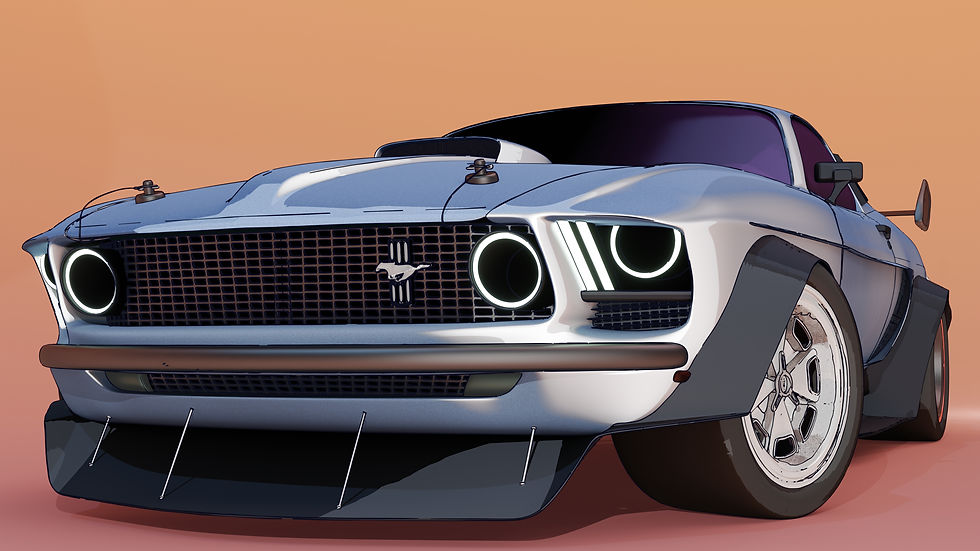
The original 1969 Mustang provided the starting point: the long bonnet, fastback profile, grille and overall surface language.
From there, I pushed the form into something that doesn't exist. Wider arches, a rear wing, revised side details and a more contemporary stance.
The aim wasn't to reproduce the original car exactly. It was to understand the underlying proportions well enough to reinterpret them.


THE CUT
One model. Two visual languages.
The final two seconds move away from the photoreal treatment entirely.
The film cuts to a top-down, cel-shaded composition with halftone texture, illustrated smoke, skid marks and graphic linework.
The same geometry has to remain recognisable after the realism is removed. That makes the transition more than a stylistic change. It tests whether the form itself is strong enough to carry the image.




Like what you see? Thinking about working together?
Drop me a line here. I’m always up for a chat - especially with people who are passionate about what they do.
WHY IT MATTERS
One asset. Multiple visual directions.
The Mustang was built as a single 3D asset, but the final piece takes it through two very different treatments: photoreal and cel-shaded.
That flexibility is one of the reasons I work in 3D. The same underlying asset can become a product film, campaign image, stylised social content or a completely different visual direction without starting the production from scratch.
The Mustang is a more demanding version of the same principle I apply to product visualisation: build the asset well, and the possibilities stay open.